
Table of Contents
Quick Answer: To secure doors and windows, strengthen the entire opening rather than focusing only on the lock. For doors, use a dependable deadbolt, solid exterior door, reinforced strike plate, long screws reaching the wall framing, a sound jamb, and secure hinges. For windows, use working locks, repair damaged frames, add secondary locks where appropriate, and consider laminated glass, security film, or quick-release grilles for vulnerable openings. Supporting security layers such as lighting, cameras, sensors, and trimmed landscaping add visibility, detection, and deterrence.
After years of working as a locksmith, I learned that securing an exterior entry point rarely starts and ends with the lock. A dependable lock matters, but it is only one part of the opening. If the door splits, the frame breaks, the strike plate pulls loose, or the hinge side fails, an intruder may never need to defeat the lock itself.
I have seen this firsthand while being called to repair and resecure homes after break-ins. In one case, an older surface-mounted lock was still hooked between the door and frame, with a broken piece of the door hanging from it. The lock had done its job. The door around it had failed. Experiences like that taught me that the strongest lock in the world cannot protect an opening if the door, frame, or surrounding material gives way first.
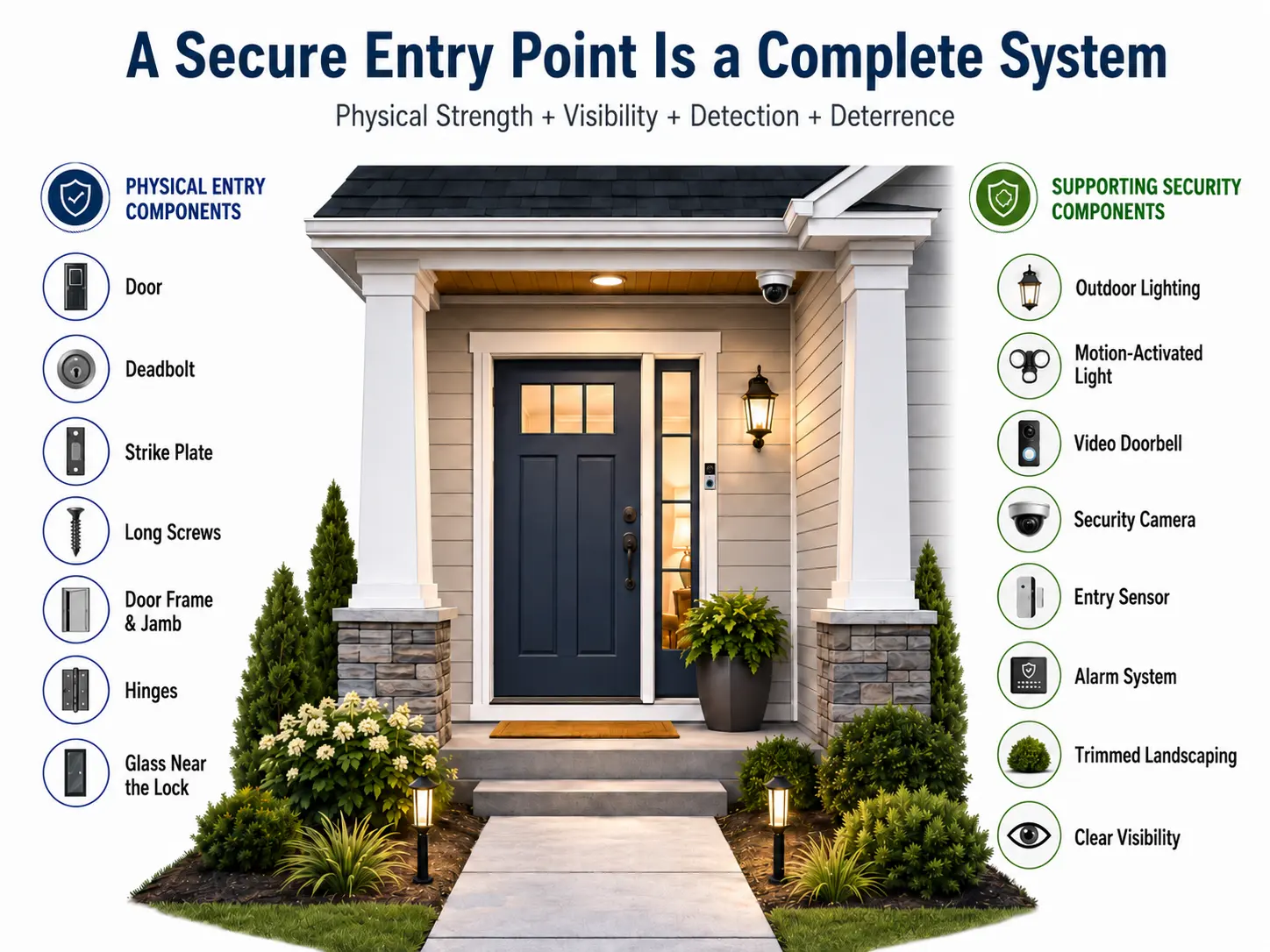
A secure entry point works as a connected system. The door, deadbolt, frame, strike plate, screws, hinges, glass, and surrounding wall framing must all resist force together. The weakest component often determines how easily the opening can be forced.
Security also extends beyond the physical opening. Good outdoor lighting, motion-activated floodlights, trimmed landscaping, video doorbells, security cameras, entry sensors, alarms, and smart access controls can make it harder for someone to approach or work unnoticed. These supporting layers improve visibility, detection, deterrence, and your ability to respond.
No single product provides all of that protection. A camera may record a break-in, but it cannot reinforce a weak frame. A bright light can expose someone approaching the house, but it cannot keep the door closed. The strongest entry points combine durable physical construction with lighting, clear visibility, detection, and controlled access.
Start With a 10-Minute Door and Window Security Check
Before buying anything, inspect every exterior opening around your home. Include the front door, back door, side door, basement door, garage service door, garage-to-house door, sliding doors, basement windows, and any upper-level windows that can be reached from a deck, porch roof, tree, fence, or stored ladder.
For each exterior door:
- Close it and confirm the deadbolt extends fully without lifting, pushing, or pulling the door.
- Push and pull near the lock to check for excessive movement.
- Look for cracks, loose trim, missing screws, or damage around the strike plate.
- Inspect the door edge around the deadbolt and latch for splits or previous repairs.
- Check the hinges and confirm the screws are tight.
- Look through nearby glass and determine whether someone could reach the interior lock after breaking it.
For each window:
- Close it completely and operate the lock.
- Gently try to move the sash after it is locked.
- Look for cracked frames, loose hardware, or locks that no longer align.
- Check whether shrubs, fences, sheds, or other objects conceal the window from view.
- Confirm that any bedroom or basement escape window can still be opened quickly from inside.
Former Locksmith’s Tip: The lock is not always the best place to start when improving an entry point. Instead, ask what would fail first if the door were pushed, kicked, or pried. The weak point may be the frame, strike plate, screws, hinges, damaged door edge, or glass beside the lock. Start by strengthening the part most likely to fail.
What Should You Fix First?
| Priority | Problem | Best First Step | Typical Difficulty |
|---|---|---|---|
| 1 | Deadbolt does not extend fully | Correct the door and strike plate alignment | Easy to moderate |
| 2 | Weak, loose, or damaged door frame | Repair the frame and reinforce the strike area | Moderate |
| 3 | Exterior door has only a knob or lever lock | Add a properly installed deadbolt | Moderate |
| 4 | Sliding door relies only on its factory latch | Add a fitted track barrier and anti-lift protection | Easy |
| 5 | Accessible window has a weak or broken lock | Repair it or add a lock designed for that window type | Easy |
| 6 | Dark or concealed entry point | Improve lighting and remove nearby hiding places | Easy to moderate |
How to Build a Complete Door Security System
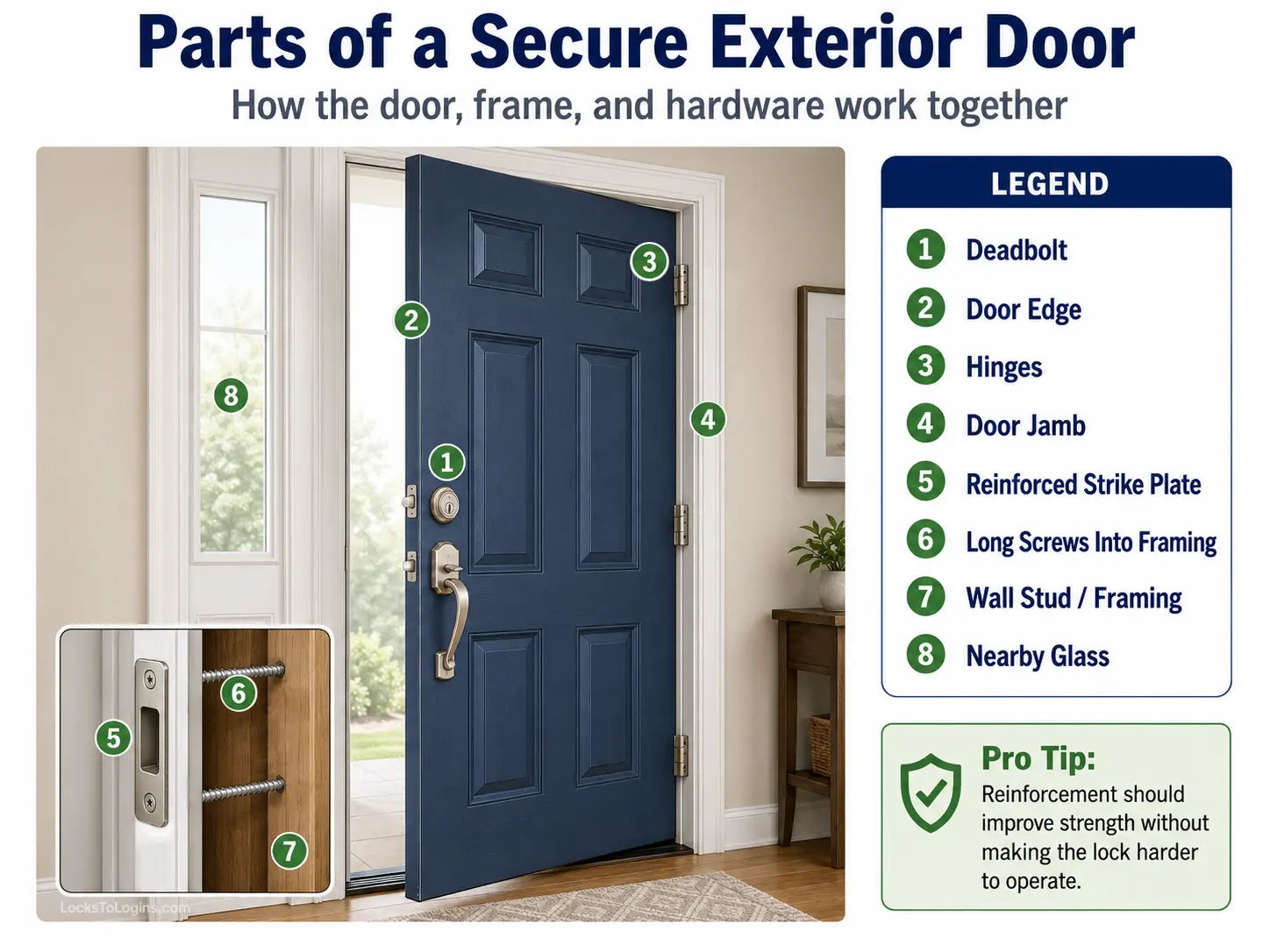
A secure exterior door is only as strong as its weakest component. The lock must hold, the strike plate must remain attached, the frame must resist splitting, the screws must reach solid framing, the hinges must stay secure, and the door itself must withstand impact. Improving these parts together provides far more protection than spending the entire budget on one expensive lock.
Parts of a Secure Exterior Door
| Component | What It Does | Common Weakness | What to Check |
|---|---|---|---|
| Deadbolt | Secures the door to the frame | Poor alignment or incomplete bolt extension | Confirm the bolt extends fully without forcing the door |
| Door | Resists impact and supports the lock | Hollow construction, splits, or damage near the lock | Use an exterior-rated solid-core, fiberglass, wood, or metal-skinned door |
| Strike plate | Receives and supports the deadbolt | Small plate attached only to the thin jamb | Use a reinforced strike that spreads force across the frame |
| Screws | Connect the hardware to structural framing | Short screws that pull out of the jamb | Use appropriate long screws in strategic strike and hinge locations |
| Frame and jamb | Hold the door and locking hardware in position | Thin, cracked, loose, or previously repaired wood | Repair damage and reinforce the jamb where needed |
| Hinges | Support and secure the opposite side of the door | Loose screws or exposed removable pins | Tighten the hardware and protect exposed hinges |
| Nearby glass | Allows light and visibility around the entrance | Broken glass may provide access to the interior lock | Check whether the lock can be reached through adjacent glass |
1. Use a Real Deadbolt on Exterior Doors
A spring latch inside a knob or lever is convenient, but it should not be the primary security lock on an exterior door. A deadbolt extends a solid bolt into the frame and provides much better resistance to pushing and prying.
Look for residential hardware that has been independently tested under a recognized ANSI/BHMA standard. The important point is not the marketing phrase on the package. It is whether the specific product has a legitimate certification and whether it is installed correctly.
A smart lock can improve convenience, temporary access, and activity records, but it cannot compensate for a weak frame or damaged door. Fix the physical opening first, then use the Smart Lock Purchase Guide to compare electronic features.
The deadbolt is the locking part of the system, but it can resist only as much force as the door and frame supporting it.
2. Make Sure the Door Is Strong Enough
Exterior doors should be solid wood, solid-core composite, fiberglass, or metal-skinned products intended for exterior use. A hollow interior door does not become a secure exterior door simply because a good lock is installed in it.
Inspect the edge around the deadbolt and latch. Splits, oversized holes, repeated screw repairs, and crushed wood can weaken the lock area. A wraparound reinforcement plate may help when damage is limited, but severe damage may justify replacing the door rather than covering the problem.
A strong lock cannot compensate for a hollow, split, or badly damaged door.
3. Reinforce the Strike Plate and Door Frame
The strike plate is the metal piece attached to the frame that receives the latch or deadbolt. Many basic installations use short screws that fasten only into the thin door jamb. A stronger installation uses appropriate screws long enough to reach the structural framing behind the jamb, commonly around 3 inches in residential construction.
A larger security strike or full-length jamb reinforcement plate spreads force across more of the frame. This can be more effective than relying on a small plate with only two screw locations.
During forced entry, this area often matters more than the price of the lock because the frame may fail before the deadbolt does.
Former Locksmith’s Tip: Do not drive long screws so aggressively that they pull the jamb toward the wall and change the door alignment. Seat the screw heads flush, tighten them firmly, and then test the latch and deadbolt. A reinforcement upgrade should never make the lock harder to operate.
4. Strengthen the Hinge Side
The hinge side supports the full weight of the door and can loosen over time. At least one appropriate long screw in each hinge can help connect the hinge side of the jamb to the framing, provided the screw location and construction allow it.
Outward-swinging doors require special attention because the hinge pins may be exposed. Security hinges, non-removable pins, or hinge bolts can help prevent someone from removing the pins and attacking the hinge side.
Reinforcing only the lock side leaves half of the door system unaddressed.
5. Protect Glass Near the Lock
Decorative glass, sidelights, and windows near a door can create a reach-through risk if breaking the glass provides access to the interior thumb turn. Options include laminated security glazing, professionally installed security film, stronger decorative grilles, or changing the door design during replacement.
A double-cylinder deadbolt is sometimes suggested for doors near glass, but trapping occupants during a fire is a serious tradeoff. Physical glass protection is often a better place to start.
The locking system may be strong, but reachable glass can allow someone to bypass it instead of forcing it.
6. Do Not Ignore the Garage-to-House Door
The door between an attached garage and the home deserves the same attention as the front door. Once someone is inside a closed garage, they may be hidden from neighbors while working on the interior door.
Maintain any fire-rated and self-closing features required by local code. Keep the door locked, repair loose frames, and never treat the overhead garage door as the only security barrier.
How to Secure Windows Without Blocking Emergency Escape
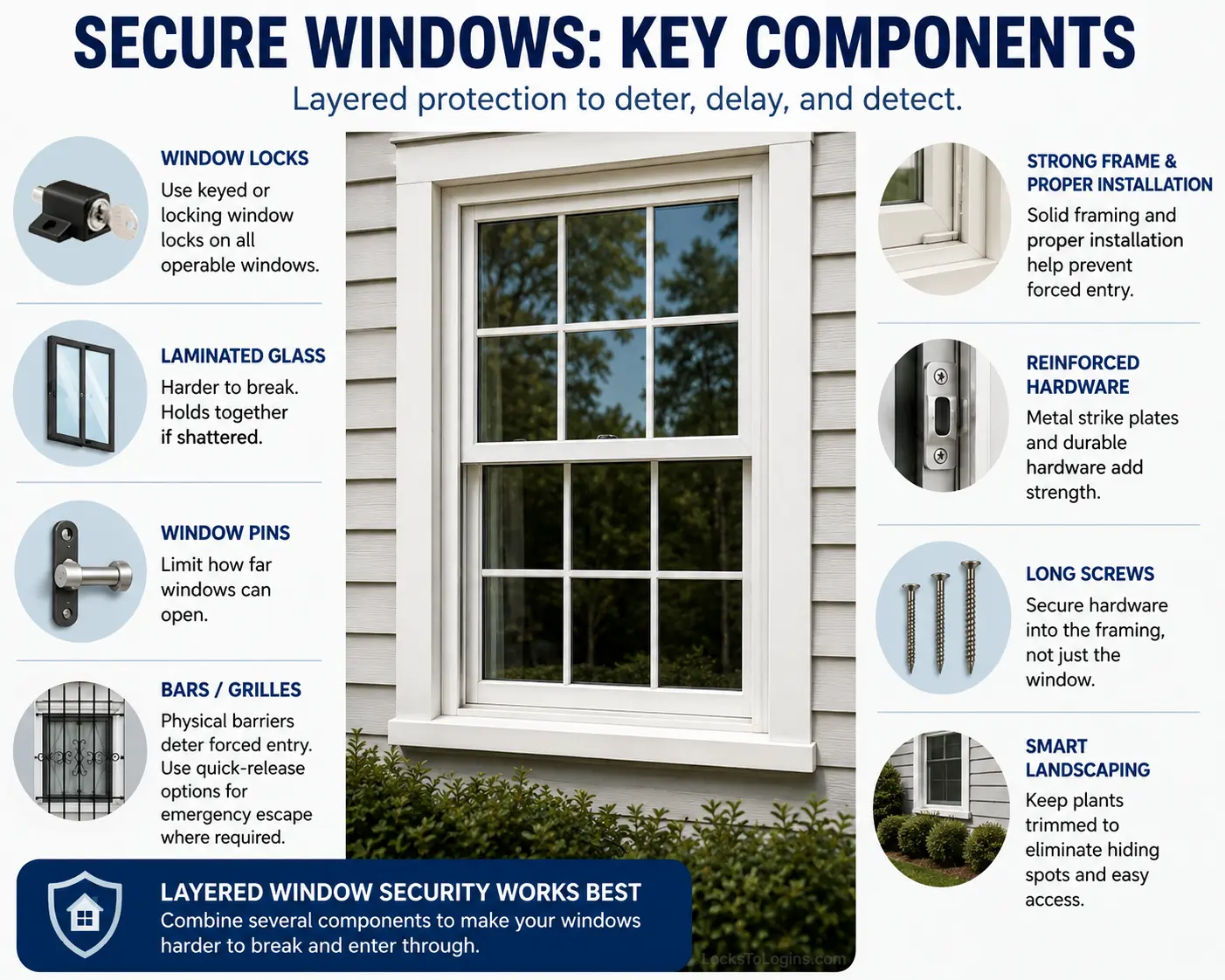
Window security should make unauthorized entry harder without creating a dangerous obstacle for the people inside. This is especially important in bedrooms and basements where a window may serve as an emergency escape opening.
1. Repair and Use the Existing Locks
A surprising number of windows appear locked even when the sash is not fully seated. Close each window completely, engage the lock, and test it by applying gentle pressure.
Replace broken or loose locks with hardware designed for the specific window type. A sliding-window lock is not automatically appropriate for a double-hung, casement, awning, or hopper window.
2. Add a Secondary Lock Where It Makes Sense
Pin locks, sash stops, track locks, and keyed locks can reduce movement after the primary latch is defeated. Choose a device that fits the way the window opens and can still be released quickly when the window is needed for escape.
For ventilation, a stop or opening restrictor can limit how far a window opens. On double-hung windows, opening the upper sash may provide airflow while keeping the lower opening less accessible. Homes with small children also need fall-prevention considerations. Any device installed on a required escape window should allow quick emergency release from inside.
3. Understand Security Film, Laminated Glass, and Tempered Glass
These products are often grouped together, but they perform different jobs:
- Security film is applied to existing glass and helps hold broken pieces together. Its effectiveness depends on the film, installation, glass, frame, and attachment method.
- Laminated glass contains a plastic interlayer that keeps much of the broken glass bonded together. It is commonly used when delayed forced entry or impact retention is important.
- Tempered glass is heat-treated for strength and safer breakage. When it fails, it is designed to break into many small pieces. That makes it valuable safety glazing, but it is not the same as laminated forced-entry glazing.
Security depends on the complete glazing system, not only the glass label. For a deeper look at film thickness, attachment methods, limitations, and costs, read Does Security Window Film Work?
Pro Tip: Film attached only to the visible glass may hold the broken pane together but still allow the entire filmed sheet to separate from the frame. Ask how the product is anchored when forced-entry delay is the goal.
4. Secure Basement and Concealed Windows
Basement windows are easy to overlook because they may be small, low, or hidden behind landscaping. They can also be attractive entry points because a person working near them may be difficult to see.
Use working locks, clear away hiding places, and consider laminated glass, security film, window-well covers, or decorative grilles where appropriate. Any grille, bar, or cover installed on a required escape opening must have an approved inside-release method and remain operable.
Best Security Options by Window Type
| Window Type | Common Weakness | Useful Upgrade | Safety Note |
|---|---|---|---|
| Double-hung | Loose center latch or unseated sash | Replacement sash lock, pin lock, or opening stop | Keep emergency release simple |
| Horizontal slider | Weak latch or excess track movement | Track lock, pin lock, or fitted barrier | Do not use a barrier that is too short |
| Casement | Worn crank or damaged locking points | Repair the operator and multipoint lock | Confirm it opens fully for emergency escape |
| Basement hopper | Hidden location and lightweight hardware | Better latch, glazing protection, or quick-release grille | Do not block a required emergency escape opening |
| Fixed window | Glass breakage rather than lock failure | Laminated glazing, security film, lighting, or sensors | Do not rely on tempered glass alone for forced-entry protection |
Secure Sliding Glass Doors With More Than the Factory Latch
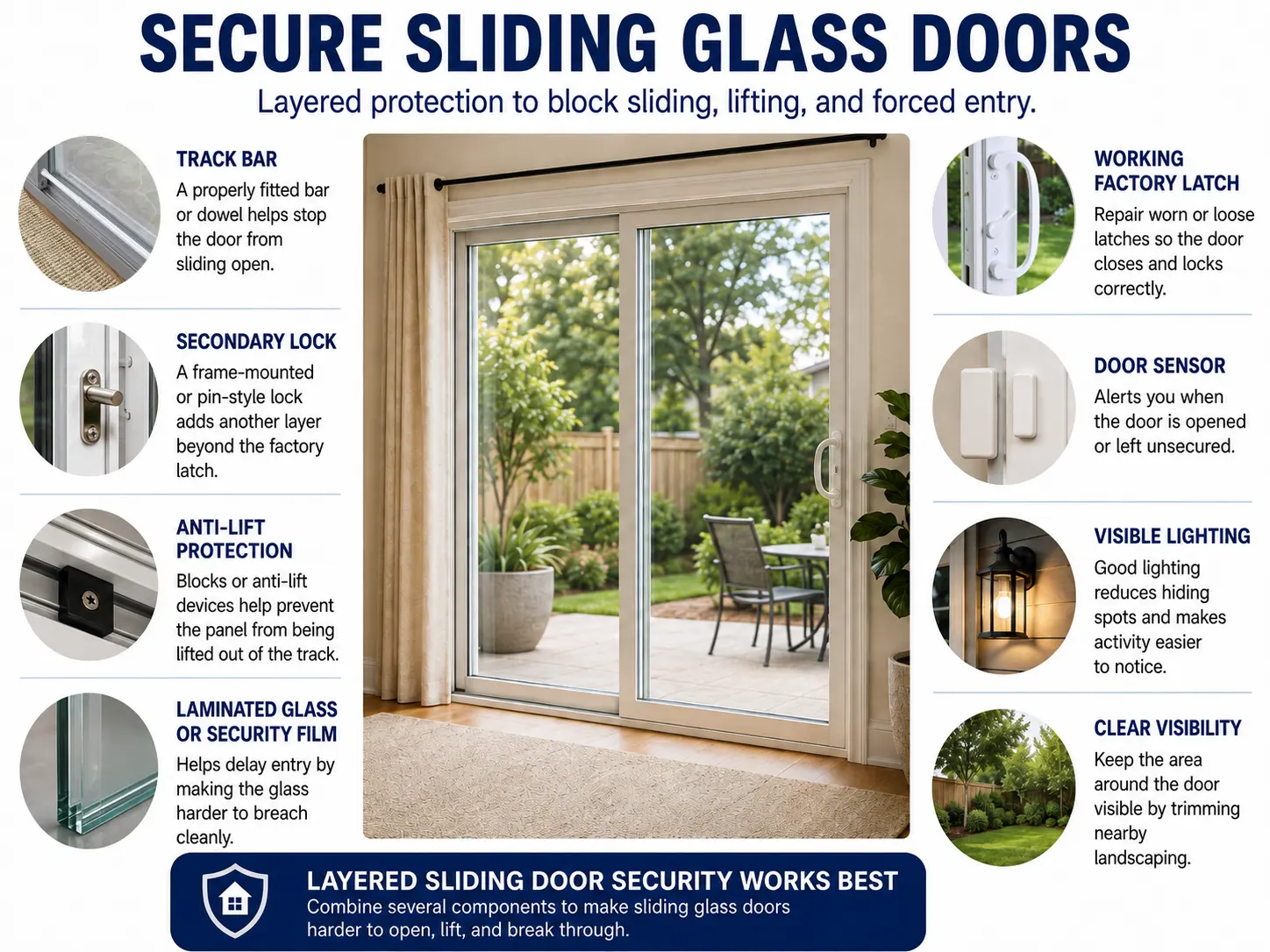
Sliding doors are also complete entry-point systems. They combine a large glass surface, a movable panel, a track, rollers, a frame, and a relatively small latch. A stronger setup addresses each way the door can be attacked:
- Sliding: Place a properly fitted security bar or dowel in the track so the panel cannot move far enough to open.
- Lifting: Use anti-lift blocks, screws, or a pin system designed to stop the panel from being lifted out of the track.
- Latch failure: Repair worn hardware and consider a secondary lock that engages the frame or fixed panel.
- Glass breakage: Consider laminated glazing, security film, curtains, lighting, and glass-break detection as supporting layers.
A track rod should leave very little movement when the door is closed. A stick that is several inches too short may look reassuring while still allowing enough travel to manipulate the latch or create leverage.
See the complete guide to securing sliding glass doors for detailed options.
Use Lighting, Visibility, Cameras, and Sensors as Supporting Layers
Physical reinforcement is the foundation because it helps keep the opening closed and buys time. The area around the entrance should then make it harder for someone to approach, hide, force entry, or leave without being noticed.
Outdoor Lighting and Motion Lights
Place lighting where it covers the normal approach to exterior doors, side yards, basement windows, detached structures, and other concealed areas. Lights should improve visibility without producing heavy glare that blinds cameras or leaves deep shadows nearby.
Motion-activated lighting can call attention to unexpected activity and reduce the amount of time someone feels comfortable near an entrance. Start with Outdoor Lighting 101 for placement and design guidance. For locations where running electrical wiring is difficult, see the solar motion flood light review.
Landscaping and Clear Visibility
Trim shrubs, decorative grasses, and tree branches that create a hidden workspace beside doors or accessible windows. Landscaping does not need to be removed entirely, but it should not block the view from the house, street, neighboring homes, cameras, or lighting.
Keep fences, storage bins, ladders, patio furniture, and other climbable objects away from upper windows and low roofs. Visible house numbers also help emergency responders locate the property quickly at night.
Video Doorbells and Security Cameras
A video doorbell can provide a close view of visitors at the primary entrance, while broader security cameras can cover driveways, side approaches, gates, rear doors, and escape routes. Position cameras to capture faces as people approach, not only the tops of their heads after they reach the door.
Use Video Doorbells 101 to compare doorbell features and placement considerations. For broader coverage, recording, and privacy considerations, see these home security camera tips.
Entry Sensors, Glass-Break Sensors, and Alarms
Door and window contact sensors can report when an opening moves. Glass-break sensors may add coverage in rooms with large or vulnerable panes. A monitored or self-monitored alarm can notify occupants and help trigger a response after an entry point is disturbed.
Detection devices are valuable, but they should support the physical system rather than replace it. A sensor can report that a weak door opened. Reinforcement can make that door harder to open in the first place.
Pro Tip: Test exterior lighting, video doorbells, and cameras after dark while someone walks the normal approach to each door. Daytime positioning can hide glare, shadows, reflections, and blind spots that become obvious only at night.
Security Improvements for Renters
Renters may not be allowed to replace doors, drill into frames, install permanent window hardware, or run new wiring. That does not mean the entry point cannot be improved.
Begin by reporting loose locks, damaged frames, broken window latches, burned-out common-area lights, and doors that do not close correctly to the property owner. Depending on the lease, useful removable options may include fitted sliding-door bars, portable door alarms, battery-powered motion lights, removable window alarms, and freestanding indoor cameras aimed at entry areas.
Before drilling, changing locks, or attaching hardware, get written approval. The guide to home security for renters covers additional no-drill and lease-friendly options.
Common Door and Window Security Mistakes
| Common Mistake | Why It Falls Short | Better Approach |
|---|---|---|
| Installing an expensive lock on a weak frame | The frame may fail before the lock does | Evaluate the door, strike plate, frame, screws, and hinges together |
| Securing only the front door | Side, rear, garage, and basement entries may be less visible | Inspect and secure every accessible entry point |
| Assuming tempered glass is burglar-resistant glass | Tempered glass is designed for safer breakage, not necessarily delayed entry | Use a tested laminated or security glazing system when forced-entry delay is the goal |
| Installing bars that block emergency escape | Occupants may be trapped during a fire or other emergency | Use code-compliant quick-release hardware |
| Ignoring a sticky deadbolt | The bolt may not be extending fully into the strike | Correct the door and strike alignment instead of forcing the lock |
| Relying on cameras alone | Recording an attempted break-in does not physically delay entry | Combine cameras with strong locks, reinforcement, lighting, and alarms |
Strengthen the Entry Point in the Right Order
Do not automatically begin with a new lock or smart device. Start with the weakest part of the opening and work outward. Correct alignment, repair damaged material, reinforce the frame and hardware, and then add detection and convenience features.
Under $50
- Correct minor deadbolt and strike alignment
- Replace loose or inappropriate strike and hinge screws
- Add a fitted sliding-door track rod
- Replace broken window locks
- Trim shrubs blocking the view of entry points
- Replace burned-out exterior bulbs
$50 to $200
- Install a reinforced strike or jamb reinforcement kit
- Upgrade a weak exterior deadbolt
- Add anti-lift and secondary locks to a sliding door
- Install motion lighting
- Add window contact or glass-break sensors
- Apply quality security film to selected vulnerable panes
Over $200
- Replace a hollow or badly damaged exterior door
- Repair or replace a weakened frame
- Upgrade vulnerable glazing to laminated glass
- Install professionally anchored security film
- Replace failing windows or sliding-door assemblies
- Add a monitored alarm system or professionally designed security lighting
Start with the weakest accessible entry point rather than the most impressive product. A modest repair that allows a deadbolt to engage correctly can provide more practical value than adding another smart device to a door that does not close properly.
Final Thoughts
Good entry-point security does not come from one impressive product. It comes from removing weak links. A dependable lock matters, but so do the door, frame, strike plate, screws, hinges, glass, and surrounding construction that support it.
Think of every exterior opening as a system. Find the part most likely to fail, strengthen it, and then move to the next weakness. Once the physical entry point is sound, lighting, landscaping, alarms, cameras, sensors, and smart locks can provide valuable supporting layers.
Walk through the same inspection twice a year and after major weather changes, door repairs, or window replacement. Homes shift, screws loosen, frames move, and hardware wears. Security improvements work only when they remain aligned, locked, visible, and maintained.
Explore more Home Security guides for related tips, tools, and reviews.
Door and Window Security FAQs
Should an exterior door swing inward or outward for better security?
Either direction can be secure when the complete assembly is designed correctly. Inward-swinging doors need strong frames and strike reinforcement because they may be exposed to kick-in force. Outward-swinging doors resist that type of attack differently, but exposed hinges require non-removable pins or other hinge protection. Local building, fire, and storm codes may also affect the correct choice.
Can a smart lock make a weak door secure?
No. A smart lock can improve convenience, access control, and activity records, but it does not repair a cracked jamb, hollow door, loose hinge, or misaligned deadbolt. Fix the physical door system first, then compare electronic features.
Are double-cylinder deadbolts safer on doors with glass?
They can prevent someone from breaking nearby glass and turning an interior thumb turn, but they can also delay escape if a key is not immediately available. Some locations restrict their use. Protecting the glass or changing the door design is often safer than creating a key-required exit.
How can I secure a window while still allowing ventilation?
Use an opening restrictor, sash stop, or lock that limits how far the window can move. A double-hung window may also be opened from the top when the design allows it. Any device on a required emergency escape window should release quickly from inside and comply with local code.
Does window security film make glass burglar-proof?
No. Security film can hold broken glass together and delay easy entry, but the result depends on the film, glass, frame, attachment system, and installation quality. It should be treated as one layer of protection rather than an unbreakable barrier. For maximum security I recommend consulting an expert.
Should I replace every hinge and strike screw with a 3-inch screw?
Not necessarily. Strategic long screws can connect the hinges and strike area to structural framing, but every hole does not always need one. Screw length, location, wiring, wall construction, and door alignment matter. Use hardware appropriate for the installation and avoid overtightening.
What can renters do without making permanent changes?
Renters can report damaged locks and frames, use fitted sliding-door bars, add portable door or window alarms, improve removable lighting, and use freestanding indoor cameras where permitted. Review the lease and get written permission before drilling, replacing locks, or attaching permanent hardware. Check out our guide Home Security for Renters: No-Drill Options That Work for more information.
How often should door and window security be checked?
Inspect it at least twice a year and after severe weather, remodeling, lock replacement, or noticeable seasonal movement. Test every lock, deadbolt, sliding-door barrier, sensor, camera view, and exterior light rather than relying on a visual check.
A secure entry point is about more than a strong lock. If this guide helped you see how doors, windows, lighting, cameras, and other security layers work together, share it with someone who wants to make their home safer.

Michael Kendrick
Director of IT and former Certified Registered Locksmith with 27 years in technology and cybersecurity. Practical, everyday guidance to help you protect everything from the locks on your doors to the logins on your accounts.
Keep Learning: More Security Guides
How to Secure a Sliding Glass Door: 7 Former Locksmith Tips
Learn how to secure a sliding glass door with 7 practical tips from a former locksmith, including better locks, track bars, anti-lift protection, glass reinforcement, and simple ways to make your
Does Security Window Film Work? Costs, Limits & Best Uses
Does security window film actually work? Learn how it slows break-ins, what thickness to choose, its limits, costs, and when it is worth installing.
Are Smart Locks Safe? A Former Locksmith Explains
Smart locks promise keyless convenience and remote access, but how secure are they really? A former Certified Registered Locksmith breaks down what works, what doesn’t, and how to choose wisely.