
Table of Contents
Quick Answer: Yes, security window film works by holding shattered glass together and making an opening harder to clear. It can slow forced entry, create more noise, and buy time, but it does not make a window unbreakable. Performance depends on the film thickness, glass, installation quality, window frame, and whether the film is attached to the frame.
What Security Window Film Can and Cannot Do
A standard window offers very little resistance to forced entry. Once the glass breaks, an intruder may be able to clear an opening, reach through, unlock a nearby door, or climb inside. Security window film is designed to make that process slower and more difficult by holding shattered glass together after impact.
So, does security window film actually work? Yes, but it has limits. It does not make glass unbreakable or turn an ordinary window into a bulletproof barrier. What it can do is force an intruder to strike the glass repeatedly, create more noise, and spend more time trying to open a path through the window.
That delay can matter because many residential break-ins are crimes of opportunity. A burglar looking for a quick and quiet entry may move on when a window requires too much force, time, and attention. Security film works best as one layer of protection alongside strong locks, exterior lighting, cameras, alarms, and window sensors.
Former Locksmith’s Take: Security film should be treated as a delay layer, not a replacement for strong locks. It is most useful on glass near a door handle, hidden ground-floor windows, and sliding doors where an intruder could quickly create an opening and reach the lock.
What Is Security Window Film?
Security window film is a thick polyester layer applied to the inside surface of a window. It works much like heavy-duty automotive tint, but its main purpose is not privacy or glare reduction. It is designed to help hold broken glass together after an impact.
Decorative and privacy films are often only 2 to 4 mils thick, while security film commonly ranges from 4 mils to 15 mils or more. One mil equals one-thousandth of an inch. In general, thicker film provides stronger glass retention, but thickness is only part of the equation. The type of glass, adhesive quality, installation, window frame, and attachment system all affect how well the finished window resists impact and forced entry.
Security Window Film Thickness Comparison
| Film Thickness | Best Use | Main Limitation |
|---|---|---|
| 4 Mil | Basic shatter protection, smaller windows, doors, and mirrors | Provides limited resistance against forced entry |
| 8 Mil | Ground-floor windows, sliding doors, and general residential security | Performance still depends heavily on installation and frame attachment |
| 12 to 15 Mil | Higher-risk windows, large glass panels, and commercial applications | More expensive and difficult to install without professional help |
How Security Window Film Works
When a filmed window is struck, the glass can still crack and shatter. The difference is that the broken pieces remain bonded to the film instead of immediately falling away and leaving a clear opening.
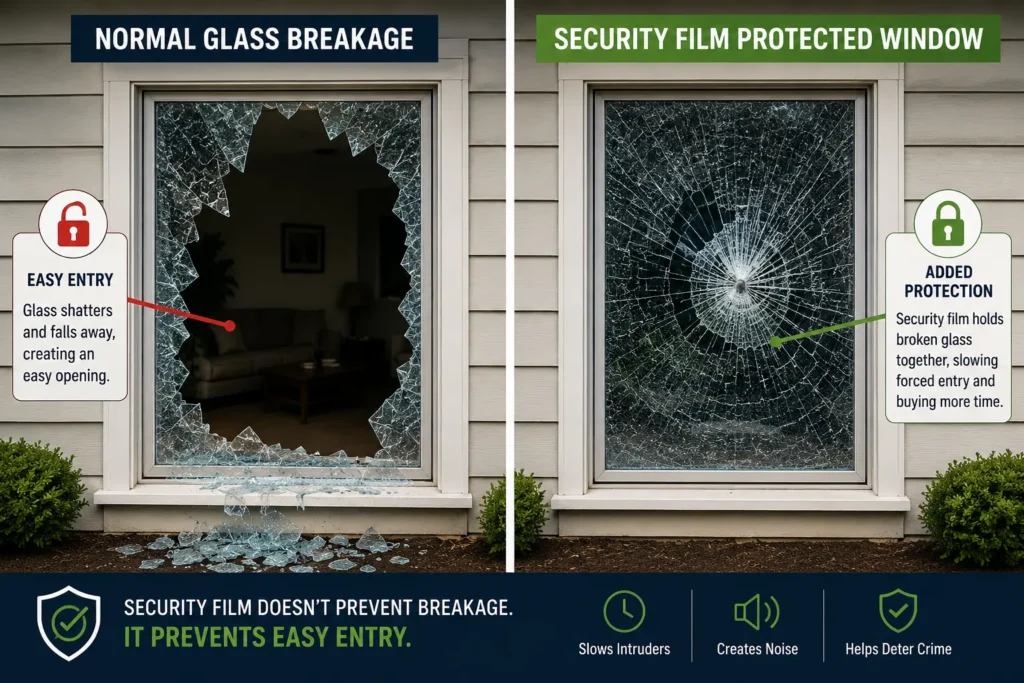
That forces an intruder to keep striking, pulling, and tearing at the damaged glass to create enough space to reach through or climb inside. The extra effort creates more noise, takes more time, and increases the chance that someone notices the break-in attempt.
How well the film performs depends on several factors, including its thickness, adhesive quality, the type of glass, installation quality, and whether the film is secured to the window frame with an attachment system. Film applied only to the glass can help hold shattered pieces together, but a frame attachment system provides stronger resistance by helping keep the filmed glass within the opening.
Even a short delay can matter because many residential break-ins are crimes of opportunity. A burglar looking for a quick and quiet entry may move on when a window requires repeated strikes and significantly more effort than expected.
Product testing can also help you compare options, but safety and security glazing standards measure different things. ANSI Z97.1 primarily evaluates safety glazing and how glass behaves after impact, while ASTM F1233 evaluates security glazing systems against defined forced-entry threats. A film that meets a safety-glazing standard is not automatically proven to resist forced entry.
Security window film is not a vault door, and a determined intruder may eventually get through. Its value is in slowing the attempt, increasing the noise, and buying more time for someone to react.
Types of Security Window Film
Security window film is available in several finishes, but appearance is only part of the decision. The film’s thickness, adhesive, glass compatibility, and installation method have a much greater effect on security performance.
Clear Security Film
Clear film is the most common choice for homes because it strengthens glass retention without noticeably changing the appearance of the window. It allows most visible light to pass through and is a practical option for entry doors, ground-floor windows, and sliding glass doors.
Clear does not mean invisible in every condition. Depending on the product and installation, you may notice a slight change in reflection or clarity when viewing the glass from an angle.
Tinted and Solar-Control Security Film
Some security films include a tint or reflective coating that reduces glare, blocks ultraviolet light, and limits solar heat entering the room. These films can improve comfort and help reduce fading on floors, furniture, and curtains while still holding shattered glass together.
Darker film is not automatically stronger film. Check the actual thickness and published test results rather than judging protection by how dark or reflective the product looks.
Frosted and Privacy Security Film
Frosted film limits visibility through the glass, making it useful for bathrooms, bedrooms, sidelights, and other areas where privacy is important. Some products combine a privacy finish with genuine safety or security film construction.
Be careful when shopping because decorative privacy film is not necessarily security film. A thin frosted or mirrored product may obscure the view but provide little resistance against forced entry. Also remember that mirrored privacy film usually works best during the day and can lose much of its privacy when the room is brighter than it is outside.
Exterior-Grade Security Film
Most security film is installed on the interior surface, where it is protected from weather and everyday damage. Exterior-grade film is available for windows that cannot be reached from inside or for certain glass systems that require an exterior application.
Exterior film is exposed to sunlight, moisture, temperature changes, and cleaning, so it may have a shorter warranty or require replacement sooner than interior film. Make sure the product is specifically approved for exterior use.
Security Film With a Frame Attachment System
An attachment system is not a separate film finish, but it can make a major difference in performance. Film alone helps keep shattered glass together. A perimeter attachment system connects the filmed glass to the window frame, making it harder for the entire damaged pane to be pushed out of the opening.
For high-risk windows, large panes, storefront glass, and sliding doors, the attachment method may matter as much as the film thickness.
What Matters Most
Choose the finish based on appearance, privacy, and heat control, but judge the security value by:
- Film thickness
- Published testing
- Glass compatibility
- Adhesive quality
- Installation method
- Whether the film is attached to the frame
A clear 8 mil film with proper installation may provide more meaningful protection than a darker or more reflective product that is only designed for privacy.
When Security Window Film Makes Sense
Security window film does not need to cover every window in your home. The best value comes from using it on the windows and glass doors that are easiest to reach, hardest for neighbors to see, or most likely to give someone quick access to a lock.
Ground-floor windows should usually be the first priority, especially those near doors, patios, decks, or low roofs. Glass beside a front or back door is also a strong candidate because breaking it may allow someone to reach through and unlock the door from inside.
Sliding glass doors deserve special attention because they combine a large glass surface with a wide entry opening. Security film can help hold the broken glass together and make it harder to clear a path through the door, but it works best alongside a strong lock, track brace, and anti-lift protection.
Location matters too. Windows facing fenced backyards, alleys, side yards, or other hidden areas give an intruder more time to work without being noticed. A highly visible window near a street or neighbor may be a lower priority than one concealed by landscaping or a privacy fence.
Security film may also be worth considering if break-ins have occurred nearby, your home is frequently unoccupied, or replacing the glass with laminated security glazing is too expensive. It is usually less disruptive than replacing the entire window and less visually intrusive than installing bars, while still adding a useful layer of delay and glass retention.
Quick Priority Check: Prioritize windows that are easy to reach, hidden from view, or close enough to a door lock that someone could break the glass and reach inside. If a window checks two or more of those boxes, it is a strong candidate for security film.
When Security Window Film May Not Be Worth It
Not every window needs the same level of protection. Upper-story windows that cannot be reached from a porch, roof, tree, or other nearby structure are usually a lower priority than ground-floor windows and glass doors.
Security film may also provide less value when the home already has strong visibility, motion-sensor security lighting, cameras, alarms, and reinforced locks. In those cases, addressing weaker entry points may do more to reduce risk than adding film to every pane of glass.
Windows already protected by security bars, shutters, or laminated security glass may not need an additional film layer. Landscaping should not be treated as protection, though. Thick shrubs and fences can sometimes give an intruder more privacy, so trimming vegetation around vulnerable windows may be a better first step.
How Much Does Security Window Film Cost?
According to HomeAdvisor’s window security film installation cost guide, professional installation commonly costs about $7 to $15 per square foot, including materials and labor. The final price depends on the film thickness, window size, accessibility, location, and attachment method. Small projects may also be subject to minimum service charges, while sliding doors, large panes, old film removal, and structural attachment systems can increase the total.
DIY film costs less upfront, but the roll price does not account for installation tools, wasted material, difficult trimming, or replacement film if the first application goes badly. When comparing professional quotes, ask for the exact film, thickness, warranty, glass compatibility, and whether a perimeter attachment system is included.
Installation: DIY vs Professional
Installation quality has a major effect on how well security window film performs. Even a thick film can fail early if the glass is not properly prepared, the adhesive does not bond evenly, or the film is cut too far from the edges.
A basic installation bonds the film to the glass and helps hold shattered pieces together. A stronger security installation may also use a perimeter attachment system that connects the filmed glass to the window frame. This helps prevent the entire broken pane from being pushed or pulled out of the opening.
DIY installation is possible on smaller, simple windows, but it takes patience and careful preparation. The glass must be thoroughly cleaned, the film needs to be positioned without wrinkles or trapped debris, and the edges must be trimmed accurately. Thick film is harder to handle than decorative film, and large panes can be difficult to install without bubbles, creases, or misalignment.
Most DIY kits do not include a frame attachment system, so they are better suited to basic shatter protection than high-risk forced-entry applications.
For small windows and lower-priority areas, a quality DIY film can be a reasonable option. For sliding glass doors, large panes, sidelights near door locks, or windows where break-in resistance is the main goal, professional installation is usually worth the added cost.
Security Window Film Product Examples
These products cover a range of needs, from basic shatter protection and privacy to thicker films designed for stronger glass retention. The best choice depends on your budget, window size, installation plans, and how much forced-entry resistance you actually need.
BDF S8MC Clear Security and Safety Window Film (8 Mil)
The BDF S8MC is a solid mid-range option that offers a good balance of cost, thickness, and everyday residential protection. At 8 mils, it is thick enough to provide meaningful shatter resistance and help keep broken glass together after an impact. The film is clear, so it does not noticeably change the appearance of the window, and it also blocks 99% of UV rays.
According to the manufacturer’s BDF S8MC product specifications, the film passes ANSI Z97.1 Class B and CPSC Category 1 testing requirements and provides 99% UV rejection. Those certifications relate to safety glazing and impact behavior, however, and should not be treated as proof that the film meets a forced-entry resistance standard.
This is a practical choice for ground-floor windows and smaller sliding-door panels, especially for homeowners who want stronger protection than a basic 4 mil film without moving into a professional-grade system.
Pros: Good 8 mil thickness, clear finish, blocks 99% of UV rays, reasonably priced
Cons: Large panes can be difficult to install without bubbles or creases, does not include a frame attachment system, performance depends heavily on installation quality
Check current price on Amazon
DUOFIRE Window Security Film (4 Mil)
This is an affordable, entry-level safety film designed to hold broken glass together after an impact. The 4 mil version is best suited to basic shatter protection on smaller windows, doors, and mirrors, while DUOFIRE also offers a thicker 8 mil option for added resistance. It is clear, self-adhesive, and marketed as helping delay forced entry by making shattered glass harder to clear from the opening.
Pros: Budget-friendly, clear finish, peel-and-stick installation, available in 4 mil and 8 mil thicknesses
Cons: No published forced-entry testing, no frame attachment system, lighter protection than thicker professional-grade films, careful installation is needed to avoid bubbles.
Check current price on Amazon
VViViD 12 Mil Clear Safety Window Film
The VViViD 12 Mil film is a heavier-duty option for homeowners who want more glass-retention strength than a typical 4 or 8 mil product. Its extra thickness helps keep shattered glass together after an impact and makes the damaged pane more difficult to clear from the opening. The film remains clear, blocks 99% of UV rays, and allows about 90% of visible light to pass through.
This is better suited to higher-risk ground-floor windows, large glass panels, or homes where break-in resistance is a greater concern. The thicker material is more difficult to position and smooth during installation, so professional installation is worth considering for large windows and sliding doors.
Pros: Heavy 12 mil construction, designed for increased glass retention, clear finish, 99% UV blocking, 90% visible light transmission
Cons: More expensive than thinner films, harder to install without bubbles or creases, no frame attachment system included, large panes may require professional installation
Check current price on Amazon
Privacy Alternative: Gila Privacy Mirror Window Film
If privacy, not security, is your main goal, this film provides a reflective exterior finish while still allowing you to see outside during the day. It offers limited glass-retention benefits and should not be considered a meaningful forced-entry deterrent. It is better suited to bathrooms, bedrooms, and ground-floor rooms where reducing visibility into the home matters more than security.
Pros: Adds daytime privacy, reflective finish reduces visibility from outside, easy to apply
Cons: Limited security benefit, not designed to delay forced entry, privacy effect is reduced at night when interior lights are on
Check current price on Amazon
Final Thoughts
Security window film works best when you understand what it is actually designed to do. It will not make a window unbreakable, but it can hold shattered glass together, slow forced entry, create more noise, and give an intruder fewer easy options.
For most homes, the smartest approach is not covering every window. Focus first on ground-floor windows, sliding glass doors, sidelights near locks, and windows hidden from neighbors or the street. Those are the places where added delay can make the biggest difference.
The film itself is only part of the equation. Thickness matters, but so do the adhesive, the type of glass, the quality of the installation, and whether the film is attached to the frame. A properly installed 8 mil film may provide more useful protection than a thicker product applied poorly.
Security film also works best as part of a layered plan. Strong locks, exterior lighting, cameras, alarms, window sensors, and trimmed landscaping can help prevent an attempt or make it more likely to be noticed. The film adds another obstacle when those deterrents are not enough.
For smaller, lower-risk windows, a quality DIY film may be perfectly reasonable. For sliding doors, large panes, or windows where forced-entry resistance is the main goal, professional installation is usually worth the added cost.
The real value of security window film is not that it stops every intruder. It is that it turns a quick, quiet entry into a slower, louder, and more frustrating one. Sometimes, that is exactly what makes a burglar decide your home is not worth the effort.
Explore more Home Security guides for related tips, tools, and reviews.
Security Window Film FAQs
Does security window film prevent break-ins?
Security window film cannot guarantee that an intruder will not get through. Its main purpose is to hold shattered glass together and make it harder to create a large opening. This can force someone to strike the window repeatedly, create more noise, and spend more time at the entry point. That delay may discourage an opportunistic burglar, especially when the window is also protected by lighting, cameras, sensors, and strong locks.
What thickness of security window film is best for a home?
For many residential applications, 8 mil film offers a practical balance between cost, clarity, installation difficulty, and glass retention. A 4 mil film may be appropriate when basic shatter protection is the main goal, while 12 to 15 mil film is generally better suited to higher-risk windows and professional installation. Thickness matters, but the glass, frame, adhesive, and attachment method are also important parts of the complete system.
Is security window film installed inside or outside?
Most residential security window film is installed on the interior side of the glass. Interior installation protects the film from weather, dirt, scratches, and direct exterior exposure. Exterior-grade films are available for situations where the inside surface cannot be reached, but they may have different maintenance requirements and warranties. Always use a product approved for the location and type of glass where it will be installed.
Does security film need to be attached to the window frame?
Film applied only to the glass can still hold shattered pieces together, but it may not keep the entire broken pane secured within the opening. A perimeter attachment system connects the filmed glass to the window frame and can provide much better resistance against the pane being pushed or pulled out. Frame attachment is especially important for sliding doors, large panes, storefront glass, and windows being protected against forced entry.
How much does security window film cost?
Professional installation often costs around $7 to $15 per square foot, although prices vary by film thickness, window size, accessibility, location, and attachment method. Large panes, sliding glass doors, old film removal, and structural attachment systems can increase the total. DIY film costs less, but the roll price does not include installation tools, wasted material, difficult trimming, or corrections if the first application goes badly.
Can you install security window film yourself?
DIY installation is possible on smaller, simple panes if you are comfortable measuring, cutting, cleaning glass, and removing bubbles with a squeegee. Thick film becomes harder to position and trim as the window gets larger. A DIY application may also lack the frame attachment used in professional systems. For large windows, sliding doors, or high-priority entry points, professional installation is usually the safer choice.
Can security window film be used on double-pane or tempered glass?
Security film can often be installed on double-pane and tempered glass, but compatibility should never be assumed. The correct product depends on the glass construction, coatings, pane size, exposure to sunlight, and window manufacturer requirements. Using an incompatible film can create thermal stress or affect an existing glass warranty. Check the film manufacturer’s specifications and the window warranty before installation.
Does security window film make glass bulletproof?
No. Security window film does not turn ordinary residential glass into bulletproof or bullet-resistant glazing. It may help hold fragments together after an impact, but bullets can still pass through the film and glass. Homes or facilities with a genuine ballistic threat require tested bullet-resistant glazing systems designed for the specific ammunition and protection level involved.
Security window film works best as one part of a layered home security plan. If this guide was useful, share it with someone looking for practical ways to make their home harder to break into.

Michael Kendrick
Director of IT and former Certified Registered Locksmith with 27 years in technology and cybersecurity. Practical, everyday guidance to help you protect everything from the locks on your doors to the logins on your accounts.
Keep Learning: More Security Guides

Best Home Security for Renters: 10 No-Drill Upgrades That Work
Renters have more home security options than they may realize. Learn practical no-drill ways to secure doors, windows, sliding doors, packages, and entryways using portable upgrades you can take with you
How to Secure a Sliding Glass Door: 7 Former Locksmith Tips
Learn how to secure a sliding glass door with 7 practical tips from a former locksmith, including better locks, track bars, anti-lift protection, glass reinforcement, and simple ways to make your
Package Theft Prevention: 10 Ways to Stop Porch Pirates
Package theft is often a crime of opportunity. Learn practical ways to stop porch pirates, secure your deliveries, choose safer pickup options, and know exactly what to do if a package