
Table of Contents
Quick Answer: The best home security for renters starts with simple no-drill upgrades that make doors and accessible windows harder to force open, then adds portable lighting, sensors, or monitoring where they solve a specific problem. A door security bar, sliding-door brace, window stops, and a few basic deterrents can address many of the biggest security gaps without permanent changes or spending a lot of money. This guide walks through the best options in priority order, including the simple entry-point checks I would make first as a former locksmith before buying anything.
Renting does not mean you are stuck with whatever security came with the apartment or house. You may not be able to replace locks, drill into exterior walls, run wiring, or make permanent changes without permission, but there are still plenty of ways to make a rental harder to enter and easier to monitor.
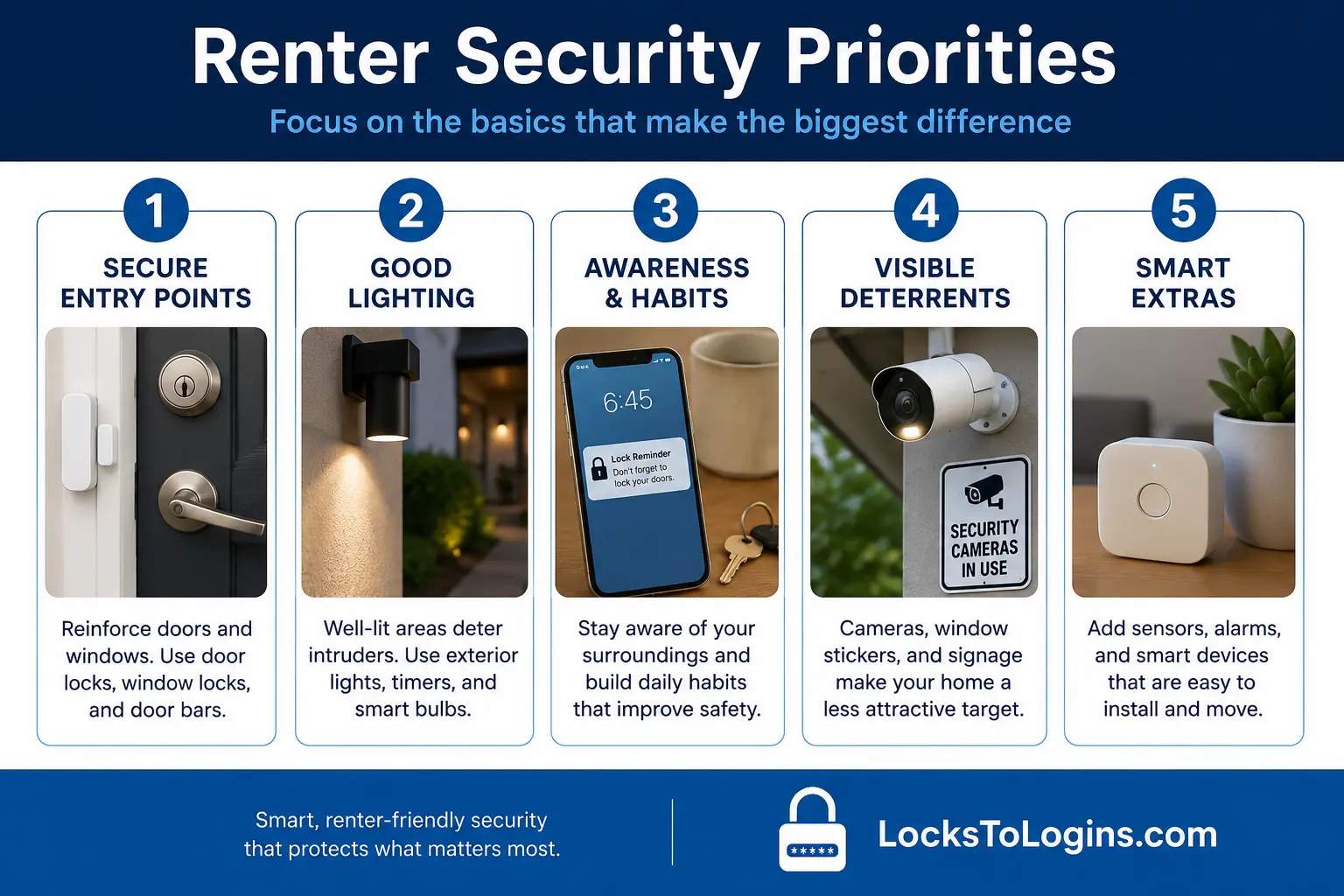
The trick is spending money in the right order. I prefer a layered approach that starts with the actual entry points, adds visibility where it helps, and uses alarms and smart devices as another layer rather than the entire security plan.
Start With the Rental, Not the Shopping List
Before filling a shopping cart with security equipment, walk through the property and look at what you already have.
Start with every exterior door. Does the deadbolt lock smoothly? Does the bolt extend completely without having to push or pull on the door? Does the door feel loose when it is locked? Is the frame damaged, cracked, or separating around the strike?
Then look at windows and sliding doors, especially anything accessible from ground level, a balcony, fire escape, porch, adjoining roof, or other easy-to-reach area.
If you recently moved in, I would also ask the landlord or property manager whether the exterior locks were changed or rekeyed before you received the keys. You may not be allowed to change them yourself, but asking is completely reasonable.
One of my favorite sayings is, “It doesn’t hurt to ask.” If a back door has only a basic knob lock, a sliding door barely latches, or a window lock is broken, bring it up with the landlord. A proper deadbolt or repaired window lock benefits the property long after you move out.
Pro Tip: Take pictures before attaching adhesive mounts, sensors, lights, or other removable products. You will have a record of the wall or trim condition before installation, and you can test adhesive in an inconspicuous area first. “Renter-friendly” does not automatically mean every adhesive is safe for every paint or finish.
Best No-Drill Home Security Upgrades at a Glance
You do not need every security product on the market. The right setup depends heavily on whether you live in a third-floor apartment with controlled building access or a single-family rental with several ground-level doors and windows.
| Security Upgrade | Best For | Permanent Change? | Works While Away? |
|---|---|---|---|
| Door security bar | Entry door while home | No | No |
| Sliding-door brace | Patio and sliding doors | No | Yes |
| Window wedges or stops | Accessible windows | Usually no | Yes |
| Lamp timer or smart plug | Creating an occupied appearance | No | Yes |
| No-drill video doorbell | Front-door visibility | Usually no | Yes |
| Battery security camera | Wider monitoring | Depends on mount | Yes |
| Battery motion light | Dark entrances and walkways | Depends on mount | Yes |
| Wireless alarm system | Entry alerts and monitoring | Usually no | Yes |
1. Strengthen the Main Entry Door
For most renters, the front door deserves attention before cameras, alarms, or other electronics.
If the existing deadbolt, latch, or frame is damaged, loose, or does not operate correctly, bring that to the landlord rather than trying to work around it with gadgets.
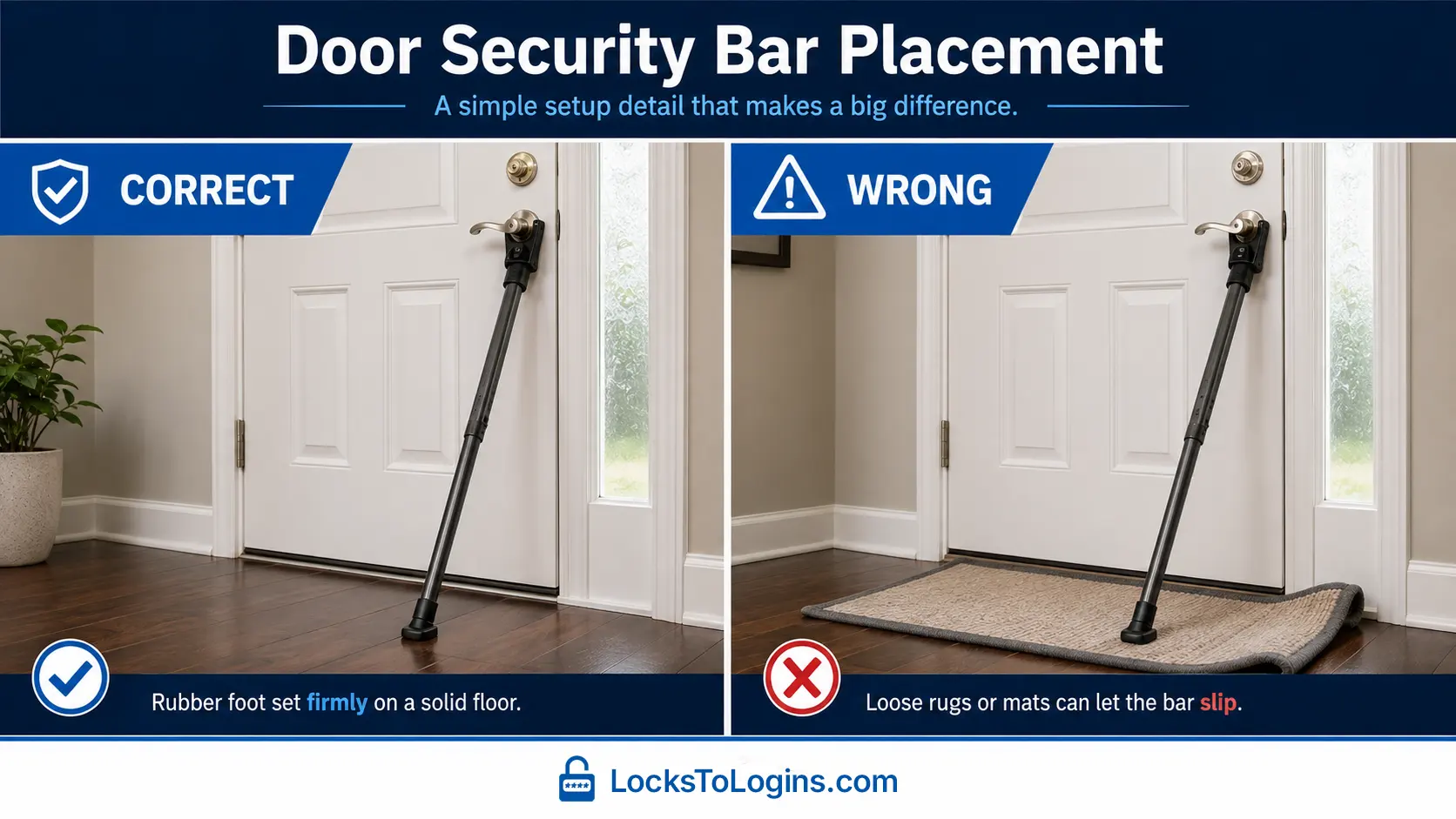
When the permanent hardware is reasonably solid, a portable door security bar can provide an additional layer while you are home. These bars typically brace between the doorknob and floor, adding resistance against the door being pushed inward. They require no screws and can move with you to your next rental.
A renter-friendly example is the SECURITYMAN 3-in-1 Door Security Bar, which can be configured for a standard hinged door or used as a sliding-door brace.
The limitation is important: a door security bar only protects the door while you are inside and the bar is installed. It does nothing while you are at work, running errands, or traveling.
Former Locksmith’s Tip: The floor matters almost as much as the bar. If the foot of a door security bar sits on a loose rug or slippery mat, the entire setup may slide when pressure is applied. Put the rubber foot directly against a solid, clean floor and make sure the bar is firmly seated before relying on it.
A good lock is only one part of a secure entry. The door, frame, strike, hinges, and deadbolt all work together. I cover those pieces in more detail in my guide to securing doors and windows.
2. Secure Sliding Glass Doors With a Track Brace
Sliding glass doors are one of the easiest rental entry points to improve without modifying anything.
A wooden dowel, cut-down broom handle, adjustable security bar, or similar brace placed in the bottom track prevents the door from sliding open even if the factory latch is defeated.
There is nothing fancy about the idea. That is part of what makes it effective.
Measure the track with the door completely closed and size the brace so there is very little room for the door to move.
If you want an adjustable option instead of cutting your own brace, there are plenty of sliding-door security bars designed for this purpose.
Pro Tip: Do not make the track brace several inches too short just because it is easier to drop into place. The more room the door has to move before hitting the brace, the more force it can build.
There is another sliding-door weakness renters should know about. Some sliding doors can be lifted vertically enough to disengage from the lower track. A track bar prevents sideways movement, but it does not automatically address a lift-out problem.
If you notice excessive vertical movement, damaged rollers, or a door that appears capable of coming out of its track, I would ask the landlord to correct it rather than drilling your own anti-lift hardware into the rental.
I cover track barriers, lift-out protection, locks, and other weak points in much more detail in How to Secure a Sliding Glass Door: 7 Former Locksmith Tips.
3. Add Secondary Security to Accessible Windows
Ground-floor and otherwise accessible windows deserve the same attention as doors.
Adhesive window wedges can be useful because they limit how far a sliding window can move without drilling into the frame. Many products originally sold for child safety also work well as simple secondary window security.
One example is the Toddleroo Window & Door Wedge Lock.
Place the wedge low and the window can remain completely closed. Move it higher and you may be able to leave the window partially open for ventilation while still limiting how far it can travel.
On compatible sliding windows, a properly sized removable track stop or wooden dowel is another inexpensive option.
Be careful around windows that may serve as an emergency exit. Do not create a security setup that is difficult to remove quickly if you need to get out.
If the factory window lock itself is broken, loose, or missing, report it to the landlord instead of treating a temporary wedge as a permanent substitute.
4. Put Lights on Timers
Security does not always require another lock.
An inexpensive outlet timer can turn lamps on and off automatically while you are gone. Smart plugs can do the same thing if you prefer controlling schedules from an app.
A simple option such as the BN-LINK Mechanical Light Timer works without Wi-Fi, an app, or a subscription.
I like timers because they are cheap, portable, and require no modifications at all.
They can also be useful if you regularly arrive home after dark. Instead of walking into a completely dark apartment, set a lamp to turn on shortly before you normally get home.
If your timer or smart plug supports multiple schedules, vary the timing a little rather than having the exact same light switch on and off at precisely the same minute every day.
5. Consider a No-Drill Video Doorbell
A video doorbell can be one of the more useful electronic upgrades for renters because it concentrates on the location where visitors, deliveries, and unexpected activity are most likely to occur.
Battery-powered models eliminate the need to connect existing doorbell wiring.
Ring, for example, offers a no-drill adhesive mount for compatible battery doorbells. Pairing a removable mount with a battery-powered Ring doorbell can create a completely wire-free setup.
The mounting surface matters. Adhesive mounts generally work best on smooth, flat surfaces. Brick, rough stucco, heavily textured siding, and some painted surfaces may not be suitable.
Before putting a camera outside an apartment, also check your lease and building rules. Shared hallways, common areas, neighboring doors, and local privacy requirements can complicate exterior camera placement.
If a hallway-mounted doorbell is not permitted, an indoor camera positioned to monitor your own entry area may be the cleaner option.
Pro Tip: Before buying a Wi-Fi doorbell, stand where the doorbell would be installed, close the front door, and check the Wi-Fi connection on your phone. Testing with the door open can give you a misleading picture of how strong the connection will actually be.
For more help comparing battery models, wired models, storage options, subscriptions, and other features, see my Video Doorbells 101 guide.
6. Use Cameras Where a Doorbell Cannot See
A video doorbell is great for watching the immediate entrance, but it does not automatically cover a patio, parking space, backyard, garage area, side entrance, or other part of the property.
That is where a separate security camera may make more sense. For renters, the key is finding a camera and mounting method that gives you useful coverage without permanently modifying the property.
A battery-powered camera is one of the easiest options because it does not require running power wiring. Depending on the location, you may be able to place one on a shelf, use a removable clamp, or attach it with another temporary mounting method.
A renter-friendly example is the Tapo C400 wire-free security camera. A battery camera like this can provide broader coverage without requiring a hardwired installation.
The mounting method is actually more important than the camera brand for renters. A camera sitting on a shelf inside the apartment requires no modification. A camera clamped to a railing may be removable. A camera screwed through exterior siding is a completely different situation and should not automatically be considered renter-friendly.
Light-Socket Security Cameras
Another interesting no-drill option is a security camera that screws directly into an existing light-bulb socket. These cameras use the socket for power, so there is no battery to recharge and no new wiring to install.
One drawback with some bulb-style cameras is that you are replacing an actual light bulb with a camera, which means you may lose an important source of lighting. Some newer models solve that problem by combining the camera and light into one device.
A good example is the WYZE Bulb Cam. It screws into a standard E26 light socket and combines a 2K security camera with an 800-lumen dimmable LED light. It also includes a 160-degree field of view, color night vision, motion and sound detection, two-way audio, a built-in siren, and optional local microSD recording.
For renters, that combination makes a lot of sense. If you already have a compatible exterior light fixture, you may be able to add camera coverage without drilling holes, running new wiring, or giving up the light that was already there.
There are still a few things to check before buying one. It is not designed for use with a dimmer switch, and the size and shape of the existing fixture matter, so make sure the camera will physically fit inside or beneath your sconce.
Pro Tip: If you use a light-socket camera in a fixture controlled by a wall switch, consider adding a small reminder near the switch so someone does not accidentally cut power to the camera. A security camera cannot record or send alerts if the socket has been switched off.
I would still treat light-socket cameras as another installation option rather than assuming every model is a good buy. Image quality, app security, storage options, Wi-Fi requirements, weather resistance, and manufacturer support can vary considerably between brands.
And as with any exterior camera or device installed in a shared apartment area, I would check with your landlord or property manager first and get approval in writing if there is any question about what is permitted.
For help choosing locations that actually produce useful footage, see Home Security Cameras: Tips to Cover Every Angle.
7. Add Motion Lighting Where It Actually Helps
Dark entrance areas, interior stairways, hallways, patios, and other poorly lit locations can often be improved without running electrical wiring.
Battery-powered motion lights are widely available with adhesive and removable mounting options.
Pay close attention to the surface. A removable strip on one type of painted wall may come off cleanly while the same adhesive can damage another finish.
In an apartment, interior lighting is usually much easier to control than exterior or shared-area lighting. If the walkway outside your apartment is poorly lit, report that to the landlord or property manager before trying to add your own exterior fixture.
If you rent a home and have control over an exterior area, my Outdoor Lighting 101 guide goes deeper into placement and common lighting mistakes.
8. Add a Wireless Alarm System if You Want Alerts
Once the physical entry points are reasonably secure, a wireless alarm can add another useful layer.
For renters, I would look for:
- Wireless door and window sensors
- Adhesive or tabletop installation options
- Equipment you can take with you when you move
- Flexible monitoring instead of a long commitment
- Reasonable replacement adhesive costs
- Clear subscription requirements
- Battery backup
- App alerts
- Optional professional monitoring if you want it
Systems from companies such as SimpliSafe and Ring are popular with renters because many of their sensors and components can be installed without hardwiring the property.
I would not choose an alarm system based only on the number of devices included in the box. A studio apartment with one exterior door has very different needs from a rental house with three doors, a garage, and ground-level windows.
A system that costs a little more but moves cleanly to your next apartment may be a much better value than one that ties you to equipment or installation you cannot take with you.
9. Protect Packages Separately
If package theft is your biggest concern, start with solutions aimed at deliveries instead of investing in a full alarm system that does little to protect a package left outside your door.
A video doorbell gives you alerts, visibility, and potentially useful footage. It does not physically secure a package sitting outside your door.
Depending on your building and delivery options, better solutions may include:
- Package lockers
- Secure pickup locations
- Delivery instructions
- A staffed leasing office
- A locking parcel box where permitted
- Having high-value deliveries held for pickup
My Package Theft Prevention guide covers that problem in much more detail.
10. Secure the Technology Behind Your Security Devices
One thing renter-security articles often overlook is that video doorbells, wireless alarms, smart plugs, cameras, and other connected security devices depend on online accounts and your home network.
If you add them, secure those too.
Use a unique password for each security account. Turn on multi-factor authentication when the manufacturer provides it. Keep the apps and device firmware updated.
Your Wi-Fi signal also needs to reach wherever the camera or doorbell is installed. A device that constantly disconnects is not very useful.
For connected cameras, doorbells, and alarm devices, my Home Wi-Fi Security guide walks through the network side of the setup.
What I Would Buy First
You can spend hundreds of dollars on renter security very quickly. Most people do not need to.
If I Had About $50
I would concentrate almost entirely on physical security:
- A door security bar
- Sliding-door or window braces where needed
- Window wedges or stops
- One or two inexpensive lamp timers
That closes several simple gaps without subscriptions, apps, batteries, or permanent installation.
If I Had $100 to $200
I would handle the physical upgrades first, then add either a battery video doorbell or one well-placed camera.
Which one I chose would depend on the problem I was actually trying to solve.
If I Wanted a More Complete Setup
I would combine:
- Physical door and window security
- Doorbell or camera coverage
- Lighting
- Wireless door and window sensors
- An alarm base station
- Optional professional monitoring
The important part is the order. Do not spend hundreds of dollars on electronics while ignoring a door that does not lock correctly or a sliding door that can be opened with almost no resistance.
Different Rentals Need Different Security
A secure third-floor apartment with controlled building access has very different needs from a detached rental house.
Upper-Floor Apartment
Focus most heavily on:
- The main entry door
- Package security
- A video doorbell if permitted
- A wireless entry sensor
- Interior lighting
Ground-Floor Apartment
Add more attention to:
- Accessible windows
- Sliding patio doors
- Patio or balcony access
- Exterior visibility
- Window sensors
Single-Family Rental
You may also need to think about:
- Multiple exterior doors
- Garage access
- Side and back entrances
- Ground-level windows
- Exterior lighting
- Wider camera coverage
This is why I would not recommend buying a prebuilt “renter security package” until you have actually walked the property and identified the weak points.
When the Landlord Should Be Part of the Solution
Not every security problem should be solved with something you buy.
Ask the landlord or property manager about:
- Broken or loose locks
- Missing deadbolts
- Damaged door frames
- Broken window locks
- Sliding doors that do not latch correctly
- Poorly lit common areas
- Damaged building entrance doors
- Exterior doors that do not close or latch automatically
- Whether your unit was rekeyed before you moved in
That last question is especially worth asking.
As a renter, you usually have no way to know how many copies of an old key were made by previous occupants. Rather than immediately replacing the lock yourself, ask the property owner what their lock-change or rekey process is.
Landlords can also improve rental property security without turning the unit into a construction project. Repairing existing locks, improving lighting, correcting damaged door frames, replacing broken window hardware, and addressing poorly functioning sliding doors can all make a meaningful difference without requiring major permanent changes.
Renter Security Mistakes to Avoid
Buying Electronics Before Fixing the Entry Point
Cameras and alarms provide awareness, alerts, and evidence. They are not replacements for functional locks and physical barriers.
Assuming Every “No-Drill” Product Is Damage-Free
Adhesive strips, tape, clamps, and mounts can still damage paint or finishes. Test adhesive first, follow the removal instructions, and photograph the surface before installation.
Blocking an Emergency Exit
A security device should not create a new safety problem. Make sure door bars, window stops, and other interior devices can be removed quickly when necessary.
Forgetting That Portable Door Bars Only Work While You Are Home
A door jammer or security bar can be excellent nighttime protection, but it cannot protect an empty apartment.
Mounting a Camera Before Checking Building Rules
Apartment hallways and shared spaces deserve extra consideration because your camera may capture people who are not entering your unit.
Paying for a Large System You Do Not Need
A small apartment with one entrance may need only a few devices. A detached rental house may need considerably more.
Buy for the property you actually have, not for the size of the security package being advertised.
Final Thoughts
The best home security for renters is not necessarily a complete alarm package or an expensive collection of cameras. Start with the places someone could actually enter.
Make sure the existing locks work. Secure sliding doors and accessible windows. Add a portable door bar when it makes sense. Then decide whether lighting, cameras, sensors, or professional monitoring solve a problem you actually have.
That approach is usually cheaper, easier to move, and more practical than buying security equipment simply because it is marketed toward renters.
One of the biggest advantages of renter-friendly security is that most of the equipment belongs to you. A camera, wireless alarm, door bar, timer, or removable sensor can move with you and become the starting point for securing your next home.
You may not own the property, but you still have plenty of options for making it safer without drilling holes, making permanent changes, or spending a fortune.
Important Note: Lastly, if you are thinking about adding any security device or making changes to a rental, I would check with your landlord or property manager first and get any approval in writing. An email or other written confirmation gives you a record of what was approved and can help avoid problems later if management changes or there is a question about the modification when you move out. It also makes sure everyone understands how access should be handled if maintenance, repairs, or an emergency comes up.
Explore more Home Security guides for practical advice on securing doors, windows, cameras, lighting, and other parts of your home.
Home Security for Renters FAQs
Can renters install a home security system without landlord permission?
I would always advise anyone considering an alarm system to check with their landlord or property manager before installing anything, even if the system is wireless and does not require drilling. Leases and local laws may have rules about security equipment, exterior cameras, changing locks, or modifying the property. It is also a good idea for the landlord to know an alarm system is installed in case they need authorized access for maintenance, repairs, or an emergency. You may still have plenty of renter-friendly options, including adhesive sensors and tabletop equipment, but confirm what is allowed before installing anything.
What makes a home security system good for renters?
Look for wireless equipment, removable sensors, portable components, flexible monitoring, and equipment that can move with you. Also check subscription costs and whether replacing mounting adhesive is easy when you move.
Should I ask my landlord to rekey the locks when I move in?
Yes, it is worth asking whether the locks were changed or rekeyed between tenants. Policies and legal requirements vary by location, so ask the landlord or property manager what was done rather than assuming previous keys no longer work.
Do door security bars work when nobody is home?
No. A typical door security bar braces the door from the inside, so it only works while someone is home. Use it as an additional nighttime or at-home barrier, not as a replacement for the permanent deadbolt.
Can renters put security cameras in apartment hallways?
That depends on the lease, building policy, camera placement, and applicable privacy laws. Cameras inside your own rental are generally less complicated than cameras aimed into a shared hallway. Check the rules before mounting exterior equipment.
Can removable security products still damage my security deposit?
Yes. Adhesive strips, tape, clamps, and mounts can sometimes damage paint or finishes. Test adhesive first, follow removal instructions, and photograph the surface before installation. If you are adding anything that could potentially damage the property, I would also get your landlord or property manager’s permission in writing so there is a clear record of what was approved if questions come up later.
Are window security bars or stops safe to use in bedrooms?
Only if they do not prevent emergency escape where the window is required for egress. Any security device used on an emergency exit should be easy to release quickly from inside.
Do renters need professional alarm monitoring?
Not necessarily. Self-monitoring may be enough for someone who mainly wants alerts, while professional monitoring adds third-party response when an alarm is triggered. The better choice depends on your budget, property, schedule, and how much response you want when you are away.
Renters have more ways to improve security than they may realize, and even a few simple upgrades can make a real difference. If this guide gave you some useful ideas, share it with someone who rents a home or apartment.

Michael Kendrick
Director of IT and former Certified Registered Locksmith with 27 years in technology and cybersecurity. Practical, everyday guidance to help you protect everything from the locks on your doors to the logins on your accounts.
Keep Learning: Related Security Guides
Package Theft Prevention: 10 Ways to Stop Porch Pirates
Package theft is often a crime of opportunity. Learn practical ways to stop porch pirates, secure your deliveries, choose safer pickup options, and know exactly what to do if a package
Video Doorbells 101: What to Know Before You Buy
Video doorbells can do much more than show you who is at the door, but the right model depends on your wiring, Wi-Fi, storage, subscriptions, and porch layout. This guide explains
How to Secure Doors and Windows: A Former Locksmith’s Guide
Learn how to secure exterior doors, windows, sliding doors, and frames with practical advice from a former locksmith. This guide covers the upgrades that matter most, common mistakes to avoid, and