
Table of Contents
Quick Answer: The best way to secure a sliding glass door is to layer several simple protections instead of relying on the factory latch alone. A properly fitted track barrier, a better sliding glass door lock, and protection against the door being lifted are the three places I would start. This guide walks through each one, including a simple security check I used as a locksmith before trusting any sliding glass door.
I love the sliding glass door in my dining area. It lets in a ton of natural light, opens the room to the backyard, and gives me easy access to my grill.
But after spending years working as a locksmith, I tend to look at doors a little differently than most people.
A sliding glass door is a large exterior opening that may depend on a relatively small factory latch, a pair of rollers, and a track to stay secure. If the latch is worn, the panel has too much movement, or the door can be lifted in the track, that entire opening may be easier to defeat than it looks.
The good news is that learning how to secure sliding doors usually does not mean replacing the entire patio door. Several of the most useful improvements are inexpensive, and some take only a few minutes.
The trick is to address the actual weak points instead of simply buying the most expensive security product you can find.
If you want to evaluate the rest of your home’s entry points too, my Door and Window Security guide covers exterior doors, windows, frames, locks, glass, lighting, and other common weak spots.
Are Sliding Glass Doors Secure?
They can be. The problem is relying on the original latch as if it is the entire security system.
Good sliding glass door security should address four different weaknesses:
| Weak Point | What Can Go Wrong | Best First Fix |
|---|---|---|
| Sliding movement | The panel can move if the primary latch fails or is defeated | Add a fitted track bar or dowel |
| Factory latch | Worn, loose, or misaligned hardware may not engage completely | Repair the latch and add a secondary lock |
| Vertical movement | Excess clearance can allow some doors to be lifted upward in the track | Add anti-lift protection and adjust the rollers |
| Large glass panel | Broken glass can create another path through the opening | Consider security film or upgraded glazing |
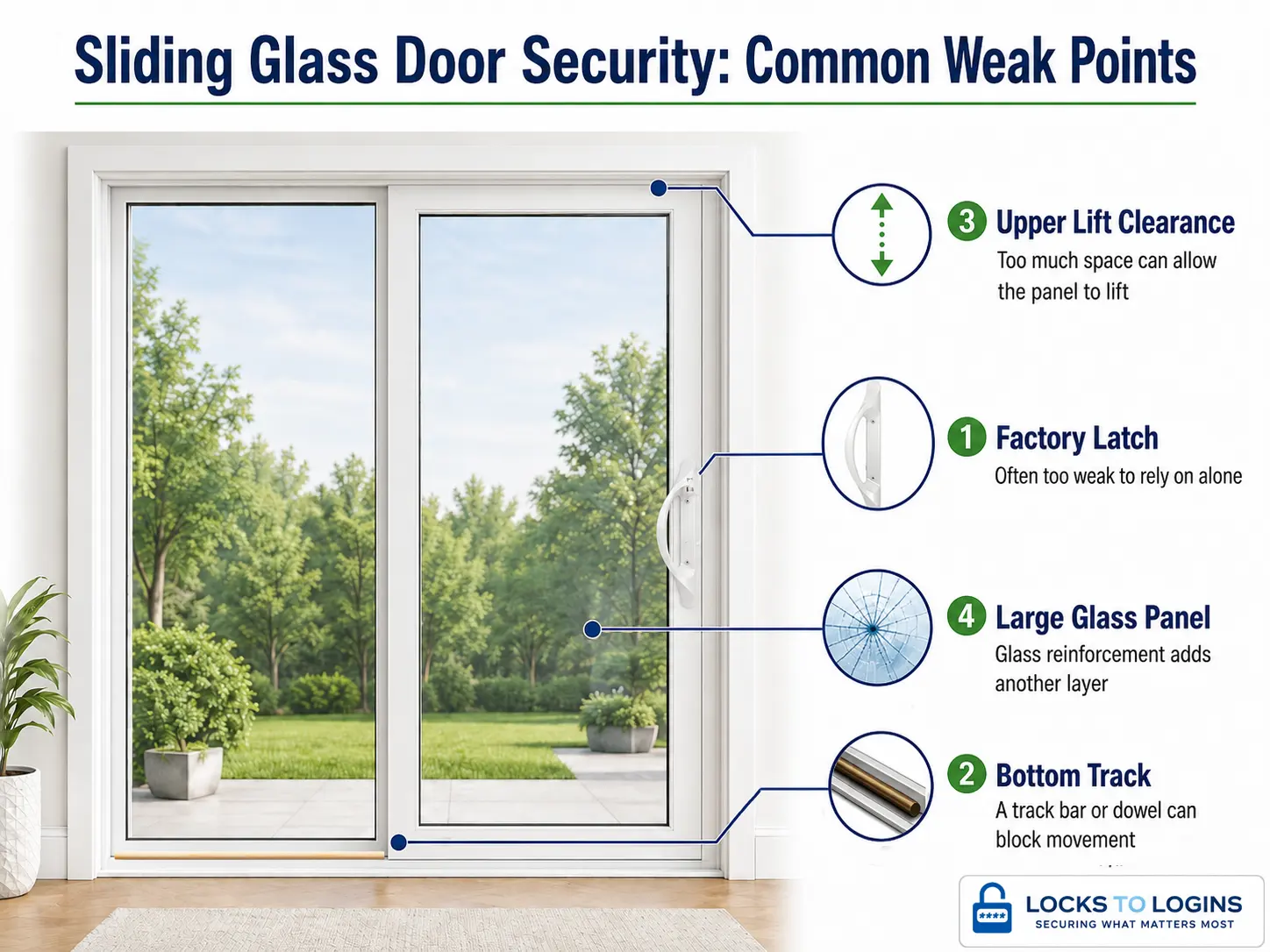
Notice that no single product addresses all four problems. Strong sliding door security comes from layering a few simple protections that solve different problems.
1. Block the Track With a Security Bar or Dowel
If you want the easiest sliding door security improvement you can make today, start with the track.
When the door is closed, place a solid barrier between the edge of the moving panel and the frame so the door cannot slide far enough to open.
Common options include:
- A wooden dowel cut to the correct length
- An adjustable sliding door security bar
- A hinged patio-door security bar designed for the door
A basic wooden dowel can work perfectly well. Measure the open section of the track with the door completely closed and cut the dowel so there is very little room for the panel to move.
A purpose-built security bar is usually more convenient because it can be adjusted to fit and easily removed when you want to use the door.
Pro Tip: After installing a track bar or dowel, try opening the door normally from inside. If the panel can still move several inches, the barrier is too short. You want very little travel once it is in place.
This is one of my favorite upgrades because it is simple, inexpensive, and creates a physical barrier that does not depend on the original latch.
2. Add a Better Sliding Glass Door Lock
The original latch should work correctly, but I would not make it the only thing securing a large exterior door.
Adding a secondary sliding glass door lock gives the moving panel another point of resistance if the original hardware becomes worn, misaligned, damaged, or manipulated.
Best Sliding Glass Door Lock Options
| Option | Best For | Main Advantage | Keep in Mind |
|---|---|---|---|
| Track bar or dowel | Simple, low-cost security | Physically blocks sliding movement | Must fit the opening closely |
| Foot lock | Frequently used patio doors | Quick to engage | Usually requires permanent installation |
| Pin lock | Simple mechanical reinforcement | Prevents the panel from moving when installed | Requires correctly aligned holes |
| Multi-position lock | Homes wanting locking and controlled ventilation | Can provide multiple stopping positions | Compatibility varies by door design |
Which option is best depends on your door and how you actually use it.
If this is the patio door you walk through ten times while grilling on a summer evening, convenience matters. A security device that is annoying to use has a habit of eventually not getting used at all.
If the door rarely opens, a fitted track barrier and simple secondary lock may be all you need.
Pro Tip: Before buying a lock, look at how your moving panel, fixed panel, frame, and track are constructed. Sliding glass doors are not all built the same way, so choose hardware designed for your particular door rather than assuming every patio-door lock will fit.
3. Stop the Door From Being Lifted Out of the Track
This is the sliding door weakness I wish more homeowners knew about.
Some sliding glass doors, especially older or poorly adjusted ones, have enough vertical clearance for the moving panel to be lifted upward. If the panel can rise high enough to clear the lower rail, securing the latch alone does not address the problem.
You can perform a simple check from inside the house.
With the door closed, gently lift upward on the moving panel. You are not trying to force it. You are simply checking how much vertical movement exists.
If the panel moves significantly, inspect the upper clearance and roller adjustment.
Depending on the door, anti-lift protection may include:
- Anti-lift blocks designed for sliding doors
- Properly positioned screws or stops in the upper track
- Roller adjustment that reduces unnecessary vertical clearance
I like this fix because it addresses something a track bar and secondary lock do not. The bar stops horizontal movement. Anti-lift protection limits vertical movement.
That is what good security layering looks like.
Important: Do not blindly drill into a sliding glass door frame. Glass can extend farther into the frame than you might expect. I learned that the hard way as a young locksmith after drilling into the side of a door and hearing a large pane of glass crack. That’s the kind of mistake you only make once. Confirm the location can safely accept hardware and stay clear of the glass.
4. Fix Worn Rollers and a Weak Factory Latch
Before piling more security hardware onto the door, make sure the door itself is working properly.
A sliding door that drags, rocks, sits crooked, or needs to be lifted before the latch catches is telling you something needs attention.
Most sliding glass doors ride on adjustable rollers near the bottom of the moving panel. Over time, the rollers can wear, collect debris, or fall out of adjustment.
That can create two security problems:
- The factory latch may no longer line up correctly with its keeper.
- Additional space can develop above the panel, increasing vertical movement.
Start by cleaning the track and checking how smoothly the door moves. If the panel is sitting too low or unevenly, the roller adjustment screws are commonly located near the bottom corners of the moving panel, sometimes behind small plastic covers.
Adjustments should leave the panel square in the opening, moving smoothly, and with as little unnecessary vertical movement as practical.
Then test the original latch.
It should engage fully without needing to push, pull, twist, or lift the door into position.
Former Locksmith’s Tip: If your sliding door is dragging or not gliding smoothly, clean the track before assuming the rollers need adjustment. I usually start with a quick vacuum and wipe-down, then rub an old candle back and forth along the clean track a few times. The wax acts as a dry lubricant and, unlike an oily lubricant, is less likely to collect dust and dirt. I’ve used this trick many times on stubborn sliding doors.
5. Reinforce the Glass if You Need Another Layer
Once the door is difficult to slide, lift, or unlatch, you can look at the large glass panel itself.
Security window film is one option. It is designed to help hold damaged glass together rather than allowing the broken pane to immediately separate into an easy opening.
That does not make the glass unbreakable. The goal is to create additional resistance and delay after the glass has been damaged.
Installation also matters. A film applied to the exposed glass is different from a complete system designed to help retain the filmed glass within its frame.
Large sliding-door panels can be challenging DIY installations because dust, bubbles, wrinkles, gaps, and alignment problems become much more noticeable across a large surface.
My guide on whether security window film really works goes deeper into film thickness, installation, limitations, and when professional installation makes sense.
If you are already replacing the entire sliding door, laminated or security-oriented glazing may also be worth discussing with the manufacturer or installer.
For most homes, though, I would still address the track, locks, rollers, and lift-out clearance before spending heavily on the glass.
6. Improve Privacy, Lighting, and Visibility
Sliding glass doors are often located at the side or rear of a home. That is great for backyard privacy, but it can also mean the door is less visible from the street or neighboring homes.
Go outside and look at the area around the door the way a stranger would.
- Do large shrubs hide the entire opening?
- Is the patio completely dark at night?
- Can you see electronics, purses, keys, or other valuables through the glass?
- Would someone standing at the door be visible from another part of the property?
You do not need to flood your backyard with light.
The goal is to remove easy concealment. Motion-activated lighting can illuminate normal approaches, while trimmed landscaping can prevent someone from having a hidden workspace right beside the door.
Blinds and curtains matter too. After dark, a brightly lit room can be surprisingly visible through a sliding glass door.
Pro Tip: Check this after dark, not just during the day. Turn on the lights you normally use in the room, walk outside, and look back through the sliding door. You may be surprised by how much of the room is visible from the yard.
For more help deciding where exterior lighting belongs, see my Outdoor Lighting 101 guide.
7. Add Sensors and Cameras for Detection
Physical security makes the door harder to open. Detection tells you when someone is interacting with it.
Several types of security devices work well around sliding glass doors:
- Contact sensor: Detects when the moving panel is opened.
- Glass-break sensor: Provides another detection layer in rooms with large glass surfaces.
- Security camera: Records activity around the patio or backyard approach.
- Motion lighting: Increases visibility when someone enters the area.
I consider all of these supporting layers. They do not replace the physical security improvements above.
A camera can record someone opening a weak door. A properly secured door can make opening it much more difficult in the first place.
If you use a camera near the patio, position it so you capture the approach to the door and useful identifying detail instead of pointing straight down at the few feet immediately in front of it.
My home security camera placement guide covers angles, blind spots, lighting, recording, and coverage in more detail.
What I Would Do First on My Own Sliding Glass Door
If I moved into a house tomorrow and found an ordinary sliding patio door secured only by the original latch, I would not start by buying the most expensive product I could find.
I would work through the door in this order:
- Test the door. Check the latch, rollers, track, and vertical movement.
- Add a fitted track barrier. This immediately limits normal sliding movement.
- Address lift-out clearance. Adjust the door or add appropriate anti-lift protection.
- Add a secondary lock. Choose one that fits the door and your normal routine.
- Improve visibility. Check lighting, landscaping, and nighttime privacy.
- Add detection. Use sensors or cameras if they fit your larger home-security setup.
- Consider the glass last. Add security film or upgraded glazing when your risk and budget justify it.
That sequence strengthens the mechanics first and adds technology afterward.
When Should You Replace the Sliding Glass Door?
Most sliding doors do not need to be replaced simply because the factory latch is not enough security by itself.
Replacement starts making more sense when:
- The frame is badly bent, cracked, corroded, or otherwise damaged
- The moving panel cannot be adjusted to sit correctly in the opening
- The roller track is severely damaged
- The locking hardware is broken and appropriate replacement parts are unavailable
- The glass or glazing system is already damaged
- You are renovating anyway and want a newer door with improved locking or glazing options
If the existing door is structurally sound and can be adjusted correctly, a track barrier, anti-lift protection, and secondary lock can provide a substantial improvement without replacing the entire assembly.
Common Sliding Glass Door Security Mistakes
Some security upgrades sound good but can create a false sense of protection when they are installed or used incorrectly.
- Relying only on the factory latch. Make it one layer, not the entire security system.
- Using a track bar that is too short. Excess movement defeats much of the point of having the barrier.
- Ignoring vertical movement. A track bar limits sliding but does not automatically prevent lifting.
- Installing anti-lift hardware so low that the door binds. The panel still needs enough clearance to operate normally.
- Adding film before repairing broken hardware. Fix the door mechanics first.
- Thinking cameras physically secure the opening. Cameras improve detection and evidence, but they do not reinforce the door.
- Making the door difficult to exit through. Everyone in the home should still be able to release the security devices quickly when needed.
Make Sliding Door Security Part of Your Routine
Even the best sliding glass door security upgrade does not help much if it is sitting beside the door instead of being used.
When you leave home or go to bed:
- Close and latch the door completely
- Put the track bar or dowel in place
- Engage the secondary lock
- Close blinds or curtains when appropriate
- Make sure exterior lighting and sensors are working normally
If you are leaving town, make the sliding door part of your larger pre-trip security check. My Vacation Home Security Checklist covers 25 things to check before you leave.
Final Thoughts
If you are wondering how to secure a sliding glass door, do not focus only on the lock.
Think about how the entire door moves.
Stop the panel from sliding. Stop it from lifting. Make sure the original latch and rollers work correctly. Then add glass protection, lighting, privacy, cameras, and sensors where they make sense.
If you only make three improvements, start with a properly fitted track barrier, add a secondary sliding glass door lock, and address lift-out clearance.
Those three layers address three different weaknesses and can make an ordinary sliding patio door much more difficult to open from the outside.
You do not need to turn your home into a fortress. Good home security is mostly about finding the easy weaknesses and removing them one at a time.
Want to keep strengthening your home? Explore more of my Home Security guides for practical tips on doors, windows, cameras, lighting, locks, and more.
Sliding Glass Door Security FAQs
Can I secure a sliding glass door without drilling?
Yes. A properly fitted wooden dowel or removable sliding-door security bar can block the track without drilling into the door or frame. Removable contact alarms and some other security devices can also be installed without permanent changes. Renters should report broken latches or damaged hardware to the property owner rather than relying on removable devices to cover up a maintenance problem.
Can a sliding glass door be secured from the outside?
Most supplemental sliding-door security devices are designed to be operated from inside, where they are less accessible to someone outside. If the sliding door is regularly used as an exterior entrance, look for a keyed locking system specifically designed for that door rather than improvising with exterior padlocks or unrelated hardware.
Is a sliding door security bar better than a wooden dowel?
Both can work well when they fit the available space closely. A wooden dowel is inexpensive and simple, while an adjustable security bar is usually easier to fit, remove, and reuse. The important part is limiting how far the panel can move once the barrier is installed.
Can I leave a sliding glass door partially open and still secure it?
Some multi-position sliding-door locks are designed to limit the panel to a small opening for ventilation. That can be useful while you are home, but a partially open door should not be treated the same as a completely closed and locked door. Consider child and pet safety before leaving any accessible opening.
Are smart sliding glass door locks worth it?
Smart features can add convenience, access control, activity records, or notifications, but they should not be your first security upgrade. Secure the physical panel, track, rollers, latch, and secondary locking points first.
Should a secondary sliding door lock be installed at the top or bottom?
Either location can work when the product is designed for that installation and the door frame can safely support it. The best location depends on the construction of the door, how often the lock is used, accessibility, and whether children can reach it.
How often should I inspect a sliding glass door for security problems?
Inspect the door whenever it begins dragging, rattling, sticking, or becoming difficult to latch. It is also worth checking periodically for latch alignment, roller movement, track damage, excessive lift, the fit of your security bar, and the operation of any sensors attached to the door.
What should families with children or pets consider when securing a sliding door?
Consider placing a secondary lock where small children cannot easily operate it while still allowing adults to release the door quickly. Avoid security devices that could create a difficult emergency exit. Multi-position locks can also help control how far the door opens, but use them according to the manufacturer’s safety instructions.
A few simple changes can make a sliding glass door much more secure. If this guide helped you spot something you hadn’t considered, share it with someone who could use the same tips.

Michael Kendrick
Director of IT and former Certified Registered Locksmith with 27 years in technology and cybersecurity. Practical, everyday guidance to help you protect everything from the locks on your doors to the logins on your accounts.
Keep Learning: Related Security Guides

Best Home Security for Renters: 10 No-Drill Upgrades That Work
Renters have more home security options than they may realize. Learn practical no-drill ways to secure doors, windows, sliding doors, packages, and entryways using portable upgrades you can take with you

How to Secure Doors and Windows: A Former Locksmith’s Guide
Learn how to secure exterior doors, windows, sliding doors, and frames with practical advice from a former locksmith. This guide covers the upgrades that matter most, common mistakes to avoid, and
Home Security While on Vacation: 25 Things to Do Before You Leave
Heading out of town? This 25-step pre-vacation home security checklist covers locks, mail and packages, cameras, smart devices, lighting, water leaks, fire risks, and a final five-minute walkthrough so you can